

10 Women’s Health Symptoms You Should Never Ignore — A Complete Guide by Dr. Pragya Ojha
Introduction
A woman’s body communicates constantly, sometimes through subtle changes that are easy to dismiss — a slightly heavier period, a dull pelvic ache, fatigue that does not go away with rest.
Most women wait. They assume the symptom will pass and adjust. They tell themselves it is not serious enough to see a doctor.
But here is the truth — the symptoms your body sends early are the ones that matter most. They are often the difference between a simple treatment and a complicated one.
This guide walks you through 10 women’s health symptoms you should never ignore — what they mean, what could be causing them, and when to seek help. Written with guidance from Dr. Pragya Ojha, a trusted gynecologist in Varanasi with over 15 years of experience in women’s healthcare at Vama Hospital, Nagwa Lanka.
Quick Answer: What Are the Most Important Women’s Health Symptoms You Should Nev
er Ignore?
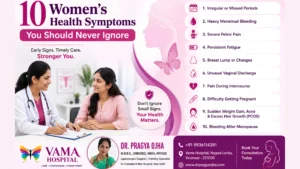
The most critical women’s health symptoms include irregular or missed periods, heavy menstrual bleeding, severe pelvic pain, persistent fatigue, breast lumps, unusual vaginal discharge, pain during intercourse, difficulty conceiving, sudden weight gain with acne and excess hair (possible PCOS), and post-menopausal bleeding. Any of these lasting more than two cycles warrants an immediate gynecological consultation.
Why Women’s Health Should Never Be Ignored
Women’s healthcare is not just about pregnancy and delivery. It is a lifelong journey — from adolescence through reproductive years to menopause and beyond.
Preventive care helps:
- Detect hormonal imbalances before they affect fertility
- Catch infections before they cause long-term damage
- Monitor reproductive health changes across life stages
- Identify conditions like PCOS, ovarian cysts, or breast changes early — when they are most treatable
- Build a health history that helps your doctor connect patterns over time
Ignoring symptoms does not make them go away. It usually makes them harder to treat later.
10 Women’s Health Symptoms You Should Never Ignore
1. Irregular or Missed Periods
What it means: Your menstrual cycle is your body’s monthly health report. When it becomes unpredictable — too short, too long, or skipping months — it signals that something is off internally.
Possible causes: Hormonal imbalance, PCOS/PCOD, thyroid disorders, extreme stress, sudden weight changes, or perimenopause.
When to consult a doctor: If your cycle has been irregular for 3 or more consecutive months, or if periods have stopped entirely without pregnancy being the reason — schedule a consultation without waiting further.
2. Heavy Menstrual Bleeding
What it means: Soaking through a pad or tampon every hour, passing large clots, or bleeding that extends beyond 7 days is not something to simply manage on your own.
Possible causes: Uterine fibroids, ovarian cysts, endometriosis, hormonal imbalance, or in some cases, conditions of the uterine lining.
When to consult a doctor: If heavy bleeding is interfering with your daily life, making you feel dizzy or fatigued, or has persisted for more than 2 cycles — see a women’s health specialist in Varanasi immediately.
3. Severe Pelvic Pain
What it means: Mild cramps during periods a
re common. But persistent, sharp, or worsening pelvic pain — especially outside of your menstrual cycle — is a warning sign.
Possible causes: Endometriosis, ovarian cysts, pelvic inflammatory disease, ectopic pregnancy, or fibroids.
When to consult a doctor: Any pelvic pain that disrupts work, sleep, or daily activities — or pain that occurs outside your period — deserves evaluation by a gynecologist.
4. Persistent Fatigue
What it means: Not the tiredness after a busy day — but deep, lasting exhaustion that does not improve with slee
p or rest. Many women normalize this, but it often has a medical cause.
Possible causes: Anaemia (very common with heavy periods), thyroid disorders, hormonal imbalance, early pregnancy, nutritional deficiencies, or chronic stress.
When to consult a doctor: If fatigue has lasted more than 2–3 weeks without improvement, especially alongside other symptoms like irregular periods, hair loss, or mood changes — get evaluated.
5. Breast Lump or Breast Changes
What it means: Any new lump, unusual pain, skin dimpling, nipple discharge, or change in breast shape or size should be taken seriously.
Possible causes: Hormonal changes, cysts, fibroadenoma, or in some cases, early signs of breast disease.
When to consult a doctor: Immediately upon noticing any change — even if it feels minor. Early detection through clinical breast examination is one of the most effective steps a woman can take. Learn more about breast disease assessment.
6. Unusual Vaginal Discharge
What it means: Some discharge is completely normal. But a change in color (green, grey, yellow), strong odour, unusual texture, or discharge accompanied by itching or burning is not.
Possible causes: Bacterial vaginosis, yeast infection, sexually transmitted infections, or cervical health changes.
When to consult a doctor: If the discharge is persistent, has changed from your normal pattern, or is accompanied by any discomfort — consult a specialist for accurate diagnosis and treatment. Read more about vaginal health.
7. Pain During I
ntercourse
What it means: Pain during or after intercourse is not something to “get
used to.” It can signal underlying conditions that need attention.
Possible causes: Vaginal infections, endometriosis, ovarian cysts, hormonal dryness (especially during perimenopause), or pelvic flo
or issues.
When to consult a doctor: If intercourse is consistently painful, or if the pain is new and worsening — consult a lady gynecologist in Varanasi in a confidential, judgment-fre
e setting.
8. Difficulty Getting Pregnant
What it means: If you have been trying to conceive for 6–12 months without success (or 6 months if you are over 35), it is time for a medical e
valuation.
Possible causes: Ovulatory disorders, PCOS, blocked fallopian tubes, hormonal imbalance, uterine issues, or male factor infertility.
When to consult a doctor: After 6–12 months of regular, unprotected intercourse without pregnancy. Earlier if you have a history of recurrent miscarriage, irregular periods, or known conditions like PCOS. Explore infertility care at Vama Hospital.
9. Sudden Weight Gain with Acne and Excess Hair Growth — Possible PCOS
What it means: When sudden weight gain appears alongside persistent jawline acne, thinning hair on the scalp, and excess facial or body hair — it often points toward a hormonal condition called PCOS (Polycystic Ovary
Syndrome).
Possible causes: PCOS/PCOD, insulin resistance, adrenal gland disorders, or thyroid dysfunction.
When to consult a doctor: If you are experiencing two or more of these symptoms together — do not wait. PCOS is far easier to manage when diagnosed early. Learn about PCOS treatment at Vama Hospital.
10. Bleeding After Menopause
What it means: Any vaginal bleeding that occurs after your periods have completely stopped (post-menopause) is a red flag that should never be ignored — regardless of how light the bleedin
g appears.
Possible causes: Endometrial changes, uterine polyps, hormonal fluctuations, or in rare cases, early signs of endometrial abnormalities.
When to consult a doctor: Immediately. Post-menopausal bleeding always requires prompt evaluation — an ultrasound and consultation with a specialist should be the first step. Read about menopause care at Vama Hospital.
When Should You Visit a Gynecologist Im
mediately?
Do not wait if you experience any of the following:
- Bleeding during pregnancy — at any stage
- Sudden, severe pelvic pain
- Post-menopausal bleeding
- A new breast lump or change in breast tissue
- Difficulty breathing, swelling, or severe headaches during pregnancy
- Foul-smelling discharge with fever
- Absent periods for 3+ months (without pregnancy)
- Recurrent miscarriage or pregnancy loss
If even one of these applies to you right now — book a consultation with Dr. Pragya Ojha today.
Can Health Apps and Wearables Help?
Yes — to a point.
Modern health apps and wearable devices can be useful tools for:
- Menstrual cycle tracking — recording cycle length, flow, and symptoms over time
- Pregnancy tracking — monitoring weekly milestones and health reminders
- Symptom logging — keeping a record of pain, discharge, mood changes, and energy levels to share with your doctor
However, these tools are not a substitute for medical evaluation. They can help you notice patterns — but only a qualified gynecologist can diagnose a condition, run the right tests, and recommend a treatment plan.
Use tracking apps as a companion to your healthcare — not a replacement.
Women’s Health Screenings Every Woman Should Consider
| Age Group | Recommended Health Check-ups |
| 13–19 years | First gynecologist consultation, menstrual health review |
| 20–29 years | Annual pelvic exam, Pap smear (from 21), hormonal panel if symptoms present |
| 30–39 years | Annual checkup, breast examination, thyroid test, fertility assessment if trying |
| 40–49 years | Mammography, bone density baseline, perimenopause evaluation, Pap + HPV test |
| 50+ years | Annual mammography, bone health screening, pelvic ultrasound, post-menopause care |
These are general guidelines. Your doctor may recommend additional or more frequent tests based on your individual health history and symptoms.
Lifestyle Tips for Better Women’s Health
Medical care is essential — but everyday habits play a massive role in long-term health.
Nutrition A balanced diet rich in iron, calcium, fibre, and protein supports hormonal balance, energy levels, and reproductive health. Avoid crash dieting — it disrupts hormonal cycles.
Exercise Regular, moderate physical activity — 30 minutes most days — improves circulation, reduces PCOS symptoms, supports bone health, and manages weight.
Sleep 7–8 hours of quality sleep supports hormonal regulation, reduces stress, and improves overall immunity.
Stress Management Chronic stress directly impacts menstrual health, hormonal balance, and fertility. Active stress management through movement, breathing, social support, or counselling is not a luxury — it is healthcare.
Regular Health Check-ups Even without symptoms, annual gynecological checkups help catch issues early. Think of them as maintenance — not emergency repair.
Can Vitamins or Supplements Help?
Certain nutrients are particularly important for women’s health across different life stages:
- Iron — essential for women with heavy periods or diagnosed anaemia
- el=”1″>Calcium & Vitamin D — critical for bone health, especially after 35
- el=”1″>Folic Acid — important before and during pregnancy for foetal development
- Vitamin B12 — supports energy, neurological health, and red blood cell production
- Omega-3 Fatty Acids — supports cardiovascular and hormonal health
Important: Supplements should only be taken after consulting a qualified doctor. Self-prescribing without proper blood work can lead to imbalances that cause more harm than good.
Why Early Diagnosis Matters
Delaying a gynecologist visit allows manageable conditions to become more complex:
- PCOS detected early is far easier to manage through lifestyle and medication
- Infections caught early rarely lead to long-term complications
- Fertility issues identified sooner have significantly higher success rates
- High-risk pregnancy factors managed early reduce complications dramatically
- Breast and cervical changes found early are far more treatable
Timely care does not just treat — it prevents.
How Dr. Pragya Ojha Can Help
If any of the symptoms above feel familiar, Dr. Pragya Ojha at Vama Hospital, Nagwa Lanka, Varanasi is here to help.
With 15+ years of focused clinical experience, she specializes in:
- Pregnancy care and normal delivery / C-section guidance
- High-risk pregnancy management
- PCOS / PCOD treatment
- Infertility evaluation and care
- Laparoscopic gynecological surgery
- Menopause care
- Breast disease assessment
- Vaginal health and infection treatment
- Ovarian cyst management
- Recurrent miscarriage investigation
- Preventive women’s healthcare checkups
Every consultation is personalized, evidence-based, and built around one principle — listening first, treating with care, and explaining clearly.
Serving Women Across Varanasi
Vama Hospital is centrally located in Nagwa Lanka, making it accessible for patients across the city.
Women regularly visit from BHU, Lanka, Assi, Sigra, Mahmoorganj, Ravindrapuri, Varanasi Cantt, Shivpur, Sunderpur, Nadesar, Orderly Bazar, and Pandeypur.
For women on the BHU and Lanka side of the city — Vama Hospital is the closest and most trusted option for expert gynecological care.
Related: Also read Top Gynecologist in Lanka Varanasi | Best Gynecologist in BHU Varanasi
Conclusion
Your body talks to you. The question is — are you listening?
Women’s health symptoms you should never ignore are not rare medical events. They are everyday signals — irregular periods, persistent pain, changes in discharge, unexplained fatigue, difficulty conceiving — that can be addressed effectively when caught early.
Do not normalize what your body is telling you. A single consultation can give you the clarity, reassurance, and treatment plan you need to take control of your health.
Book Your Appointment Today
Do not wait for symptoms to get worse. Whether it is a routine checkup or a specific concern — Dr. Pragya Ojha and the team at Vama Hospital are ready to help.
📍 Vama Hospital N1/59, A-31 Shivpuri Colony, Nagwa Lanka, Opposite Vinayak Residency, Near Gayatri Shaktipeeth, Varanasi – 221005
📞 Call: +91 9936114381 💬 WhatsApp Now — Book Your Appointment 🌐 Website: drpragyaojha.com
⏰ Clinic Timings:
Monday to Saturday — Open 24 hrs
Sunday — Only on Emergency
Follow Dr. Pragya Ojha on Social Media
Stay informed about your health. Follow Dr. Pragya Ojha for:
- 🩺 Women’s health tips and awareness
- 🤰 Pregnancy care guidance
- 🌀 PCOS and hormonal health education
- 🌸 Menstrual health awareness
- 💛 Fertility support and preconception advice
📲 Follow & stay informed — your health questions, answered simply.
Facebook: https://www.facebook.com/drpragyaojhagynecologist/
Instagram: https://www.instagram.com/drpragyaojhagynecologist
YouTube: https://www.instagram.com/drpragyaojhagynecologist
📲 Follow today — your health questions, answered simply.
Common Questions About Women’s Health
Q1. What are the top warning signs in women’s health? The most important warning signs include irregular periods, heavy bleeding, severe pelvic pain, persistent fatigue, breast lumps, unusual vaginal discharge, pain during intercourse, difficulty conceiving, sudden weight gain with acne, and post-menopausal bleeding.
Q2. When should I be concerned about
persisten
t fatigue?If fatigue has lasted more than 2–3 weeks and does not improve with sleep or rest — especially alongside symptoms like irregular periods, hair loss, or mood changes — consult a doctor. It could indicate anaemia, thyroid disorders, or hormonal imbalance.
Q3. Can irregular periods indicate a serious condition?> Yes. While occasional irregularity is common, consistently irregular periods can signal PCOS, thyroid dysfunction, or other hormonal conditions that benefit greatly from early diagnosis.
Q4. When should I consult a gynecologist? You should consult a gynecologist if you experience any persistent change in your menstrual cycle, pelvic pain, abnormal discharge, difficulty conceiving, breast changes, or me use symptoms. Annual preventive checkups are recommended even without symptoms.
Q5. Which tests are commonly recommended for women’s health screening? Common tests include Pap smear, pelvic examination, breast examination, blood tests (CBC, thyroid, hormonal panel), ultrasound, and bone density screening — depending on age and symptoms.
Q6. Can online consultation help for women’s health concerns? Yes, telemedicine is useful for initial discussions, follow-ups, and general guidance. However, physical exams, ultrasounds, and procedural treatments require an in-person visit.
Q7. Can lifestyle changes improve women’s health?
ignificantly. Balanced nutrition, regular exercise, quality sleep, stress management, and annual health checkups form the foundation of long-term women’s health — alongside medical care when needed.
Q8. Where can I find a trusted women’s health specialist in Varanasi? Dr. Pragya Ojha at Vama Hospital, Nagwa Lanka, Varanasi is a trusted choice for pregnancy care, PCOS, infertility, menopause, and complete women’s healthcare — with 15+ years of experience. Call +91 9936114381 to book.
Q9. What are the most recommended supplements for women’s health? Iron, calcium, vitamin D, folic acid, vitamin B12, and omega-3 fatty acids are commonly important for women’s health. However, supplements should only be taken after medical consultation and proper blood work — not self-prescribed.
Q10. Can health apps or wearable devices help women monitor symptoms? Health apps can help track menstrual cycles, pregnancy milestones, and symptoms over time. They are useful tools for pattern recognition — but they cannot diagnose conditions or replace a doctor’s evaluation
This content is for informational and awareness purposes only. Please consult Dr. Pragya Ojha or a qualified healthcare provider for personal medical guidance.